
When you zoom into a photo on your phone or computer, you’ll notice the individual pixels that form the image. Enlarge that same image for a billboard or scale it back for a business card, and it starts to look blurry or distorted. That’s the limitation of raster graphics.
Vector graphics work differently. Instead of pixels, they use defined paths that scale infinitely without losing clarity. Lines remain crisp, curves stay smooth, and edges don’t break apart. That scalability is why vectors are the professional standard for logos and embroidery, where clean outlines directly influence stitch precision and final quality.
When it comes to raster vs. vector graphics, the choice determines how well a design translates into thread. So, in this blog, we’ll delve into why digitizers convert raster to vector and how using vector files improves digitizing accuracy.
Let’s jump right in!
Vector vs. Raster – Why Your Designs Need to Be Vectorized
When you zoom into a photo on your phone or computer, you’ll notice the individual pixels that form the image. Enlarge that same image for a billboard or scale it back for a business card, and it starts to look blurry or distorted. That’s the limitation of raster graphics.
Vector graphics work differently. Instead of pixels, they use defined paths that scale infinitely without losing clarity. Lines remain crisp, curves stay smooth, and edges don’t break apart. That scalability is why vectors are the professional standard for logos and embroidery, where clean outlines directly influence stitch precision and final quality.
When it comes to raster vs. vector graphics, the choice determines how well a design translates into thread. So, in this blog, we’ll delve into why digitizers convert raster to vector and how using vector files improves digitizing accuracy.
Let’s jump right in!
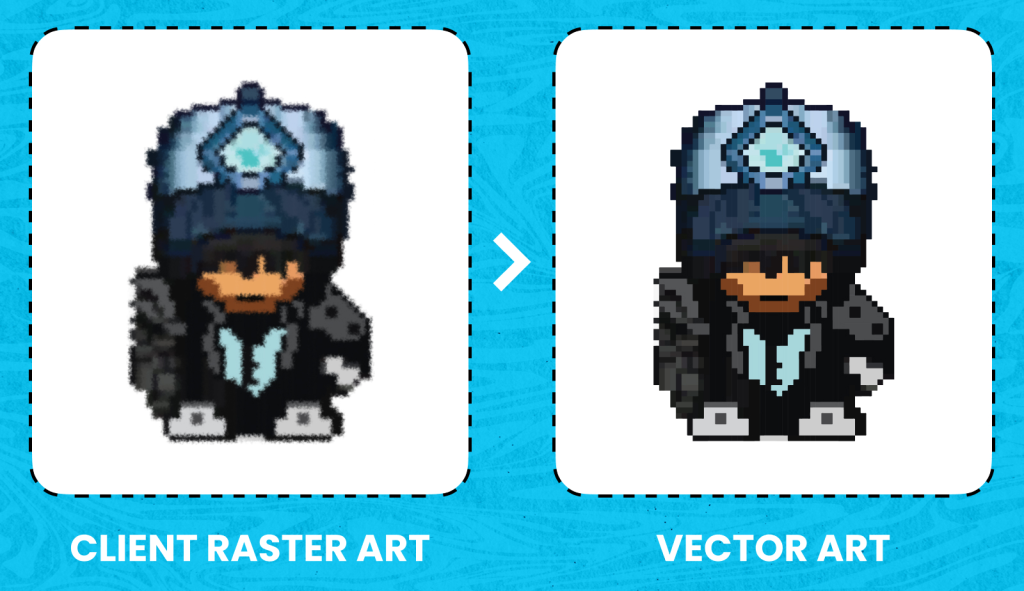
Example of how a pixel-based raster character becomes sharper and cleaner after vector conversion
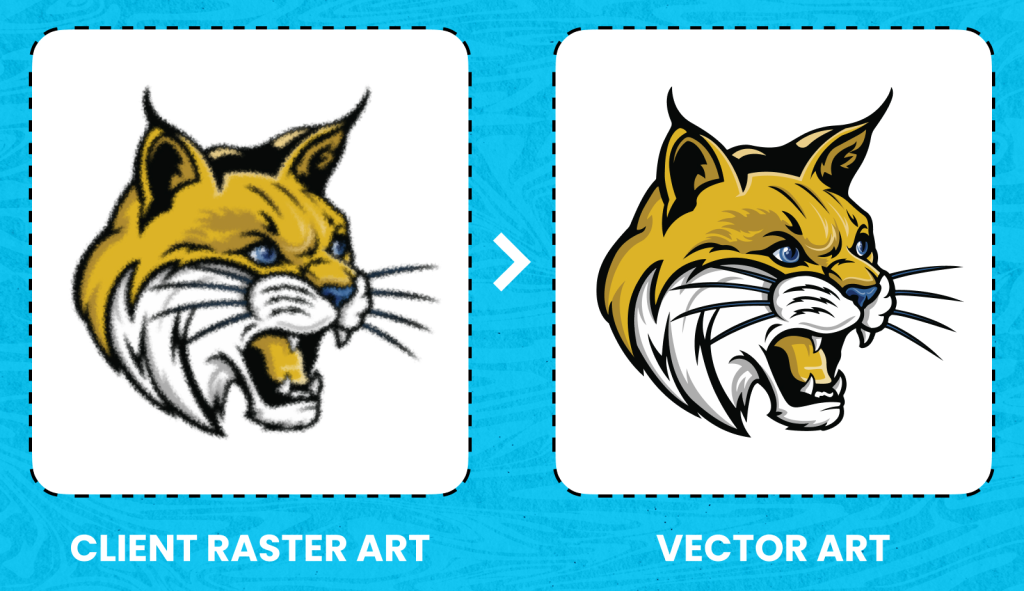
A raster wildcat logo refined into a detailed vector graphic with smooth lines and scalable quality
The difference isn’t just visual; vectorization strengthens stitch accuracy, reduces thread breaks and density issues, and guarantees production consistency, resulting in flawless, stitch-perfect embroidery every time.
Why is Vectorization Important in Embroidery Digitizing?
Vectorization is essential because it converts pixel-based, resolution-dependent (raster) artwork into clean, mathematical paths that digitizing software can accurately translate into stitch data. This precision allows for clear, high-resolution, and scalable designs that look sharp and stunning at any size.
Without a vectorized structure, embroidery files require manual reconstruction, increasing the risk of distorted edges and inconsistent stitch density. By converting raster images to vector, shape boundaries, curves, and color separations are clearly defined, ensuring precise stitch direction, underlay, and density.
The result? Cleaner outlines, smoother fills, fewer corrections, and more predictable production output, improving stitch quality and guaranteeing professional results.